

J-PAL J-PAL
The Abdul Latif Jameel Poverty Action Lab
  • About
    • Overview
    • People
    • Strengthening Our Work
    • Code of Conduct
    • Initiatives
    • Events
    • Blog
    • News
    • Press Room
  • Offices
    • Overview
    • Global
    • Africa
    • Europe
    • Latin America and the Caribbean
    • Middle East and North Africa
    • North America
    • South Asia
    • Southeast Asia
  • Sectors
    • Overview
    • Agriculture
    • Crime, Violence, and Conflict
    • Education
    • Environment, Energy, and Climate Change
    • Finance
    • Firms
    • Gender
    • Health
    • Labor Markets
    • Political Economy and Governance
    • Social Protection
  • Evaluations
  • Research Resources
    • About Us
    • Our Work
    • Join ASPIRE
    • Newsroom
  • Policy Insights
  • Evidence to Policy
    • Pathways and Case Studies
    • The Evidence Effect
  • Blog
  • Careers
  • Courses
  • For Affiliates
  • Support J-PAL

Utility menu

  • Blog
  • Careers
  • Courses
  • For Affiliates
  • Support J-PAL

Quick links

  • Evaluations
  • Research Resources
  • Policy Insights
  • Evidence to Policy
    • Pathways and Case Studies
    • The Evidence Effect
  • About

    The Abdul Latif Jameel Poverty Action Lab (J-PAL) is a global research center working to reduce poverty by ensuring that policy is informed by scientific evidence. Anchored by a network of more than 1,100 researchers at universities around the world, J-PAL conducts randomized impact evaluations to answer critical questions in the fight against poverty.

    • Overview

      The Abdul Latif Jameel Poverty Action Lab (J-PAL) is a global research center working to reduce poverty by ensuring that policy is informed by scientific evidence. Anchored by a network of more than 1,100 researchers at universities around the world, J-PAL conducts randomized impact evaluations to answer critical questions in the fight against poverty.

      • Affiliated Professors

        Our affiliated professors are based at over 130 universities and conduct randomized evaluations around the world to design, evaluate, and improve programs and policies aimed at reducing poverty. They set their own research agendas, raise funds to support their evaluations, and work with J-PAL staff on research, policy outreach, and training.

      • Invited Researchers
      • J-PAL Scholars
      • Board
        Our Board of Directors, which is composed of J-PAL affiliated professors and senior management, provides overall strategic guidance to J-PAL, our sector programs, and regional offices.
      • Staff
    • Strengthening Our Work

      Our research, policy, and training work is fundamentally better when it is informed by a broad range of perspectives.

    • Code of Conduct
    • Initiatives
      J-PAL initiatives concentrate funding and other resources around priority topics for which rigorous policy-relevant research is urgently needed.
    • Events
      We host events around the world and online to share results and policy lessons from randomized evaluations, to build new partnerships between researchers and practitioners, and to train organizations on how to design and conduct randomized evaluations, and use evidence from impact evaluations.
    • Blog
      News, ideas, and analysis from J-PAL staff and affiliated professors.
    • News
      Browse news articles about J-PAL and our affiliated professors, read our press releases and monthly global and research newsletters, and connect with us for media inquiries.
    • Press Room
      Based at leading universities around the world, our experts are economists who use randomized evaluations to answer critical questions in the fight against poverty. Connect with us for all media inquiries and we'll help you find the right person to shed insight on your story.
  • Offices
    J-PAL is based at MIT in Cambridge, MA and has seven regional offices at leading universities in Africa, Europe, Latin America and the Caribbean, Middle East and North Africa, North America, South Asia, and Southeast Asia.
    • Overview
      J-PAL is based at MIT in Cambridge, MA and has seven regional offices at leading universities in Africa, Europe, Latin America and the Caribbean, Middle East and North Africa, North America, South Asia, and Southeast Asia.
    • Global
      Our global office is based at the Department of Economics at the Massachusetts Institute of Technology. It serves as the head office for our network of seven independent regional offices.
    • Africa
    • Europe
    • Latin America and the Caribbean
    • Middle East and North Africa
      J-PAL MENA is based at the American University in Cairo, Egypt.
    • North America
    • South Asia
    • Southeast Asia
  • Sectors
    Led by affiliated professors, J-PAL sectors guide our research and policy work by conducting literature reviews; by managing research initiatives that promote the rigorous evaluation of innovative interventions by affiliates; and by summarizing findings and lessons from randomized evaluations and producing cost-effectiveness analyses to help inform relevant policy debates.
    • Overview
      Led by affiliated professors, J-PAL sectors guide our research and policy work by conducting literature reviews; by managing research initiatives that promote the rigorous evaluation of innovative interventions by affiliates; and by summarizing findings and lessons from randomized evaluations and producing cost-effectiveness analyses to help inform relevant policy debates.
    • Agriculture
      How can we encourage small farmers to adopt proven agricultural practices and improve their yields and profitability?
    • Crime, Violence, and Conflict
      What are the causes and consequences of crime, violence, and conflict and how can policy responses improve outcomes for those affected?
    • Education
      How can students receive high-quality schooling that will help them, their families, and their communities truly realize the promise of education?
    • Environment, Energy, and Climate Change
      How can we increase access to energy, reduce pollution, and mitigate and build resilience to climate change?
    • Finance
      How can financial products and services be more affordable, appropriate, and accessible to underserved households and businesses?
    • Firms
      How do policies affecting private sector firms impact productivity gaps between higher-income and lower-income countries? How do firms’ own policies impact economic growth and worker welfare?
    • Gender
      How can we reduce gender inequality and ensure that social programs are sensitive to existing gender dynamics?
    • Health
      How can we increase access to and delivery of quality health care services and effectively promote healthy behaviors?
    • Labor Markets
      How can we help people find and keep work, particularly young people entering the workforce?
    • Political Economy and Governance
      What are the causes and consequences of poor governance and how can policy improve public service delivery?
    • Social Protection
      How can we identify effective policies and programs in low- and middle-income countries that provide financial assistance to low-income families, insuring against shocks and breaking poverty traps?
Displaying 1921 - 1935 of 8333

parent child digital report
Policy insight

Providing information to students and parents to improve learning outcomes

Giving parents and students information about their educational performance or options often increases parental engagement, student effort, or both, leading to improved learning outcomes. Providing information is also typically a low-cost intervention.
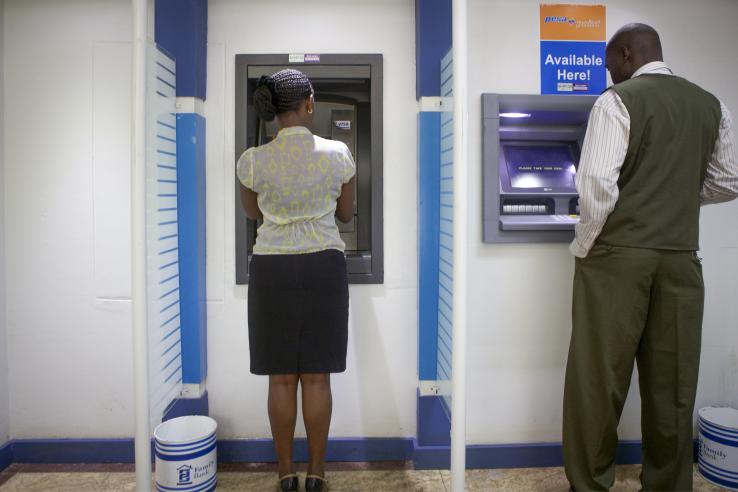
Man and woman using an ATM machine
Policy insight

Reducing the costs of saving

High costs associated with formal bank accounts are often cited as a key obstacle for low-income households to save in formal financial institutions, but lowering the cost of savings does not consistently increase savings flows, likely due to a multitude of other barriers. Given the positive welfare...

Two women gather around a computer on which an online course is displayed.
Blog

How to keep students engaged in online learning

Transitioning from a classroom to an online video conference is challenging for everyone involved—teachers must make extra effort to engage students effectively, and students in turn have to make an extra effort to stay engaged amid distractions at home. Research suggests that students typically do...
A child wearing a mask looks directly up at the camera
Blog

Adapting to learning needs in the wake of COVID-19 using data and evidence

A conversation with TaRL Africa, J-PAL, and the Ministry of National Education of Côte d’Ivoire. Originally posted by the Brookings Institute.
Three red soccer fields seen from far above
Update
J-PAL Updates

New study: In Iraq, mixed-religion soccer teams helped build social cohesion, healed wounds after war

A new study, released today in Science, points to a way to help repair social ties and promote coexistence after war. New findings show that among persecuted Christians in post-ISIS Iraq, playing on soccer teams with Muslim players helped promote more open attitudes toward Muslims, but only Muslim...
MoRD signs MoU with J-PAL South Asia on ‘Samaveshi Aajeevika’ program
Update
J-PAL Updates

Ministry of Rural Development partners with J-PAL South Asia as it expands ‘Samaveshi Aajeevika’ across India

The Government of India’s Ministry of Rural Development (MoRD) has brought the Abdul Latif Jameel Poverty Action Lab (J-PAL) South Asia at IFMR on board as a knowledge partner on ‘Samaveshi Aajeevika’, a comprehensive livelihoods programme designed to put rural women on the path to self-sufficiency.

J-PAL SA senior leadership with Government officials from Karnataka
Update
J-PAL Updates

Government of Karnataka partners with J-PAL South Asia to accelerate and scale policy innovations in school education

The partnership with J-PAL South Asia underscores the Department of School Education and Literacy's strategic, evidence-based approach to strengthen policies.
Research resource

Assessing viability and building relationships

This resource guides researchers through background research and early discussions with a program implementer who has expressed interest in a randomized evaluation, and with whom a partnership seems potentially viable. It provides guidelines for researchers to conduct early conversations with twin...
Person

Apoorva Baheti

Apoorva Baheti is a Research Support Assistant at the Haqdarshak project, which aims to leverage technology to improve access to social welfare schemes. Prior to joining in March 2020, she worked as an Actuarial Manager at ICICI Prudential Life Insurance.
Person

Allison Moore

Allison Moore is a Junior at MIT from Milwaukee, WI majoring in Economics and Math with Computer Science. At J-PAL, she works on the Bandhan Ultra-Poor projects, coordinating data cleaning with field-based RAs.

A smiling woman stands in the center of a group of other women.
Blog

What works to enhance women’s agency: Lessons from a new literature review

In honor of International Women’s Day this week, we are highlighting insights from a new literature review of the most effective approaches to improving women's agency and sharing ideas for further research.
Research Paper
File: Research paper

Saving More in Groups: Field Experimental Evidence from Chile

Research Paper
File: Research paper

No Taxation without Information: Deterrence and Self-Enforcement in the Value Added Tax

Research Paper
File: Research paper

Prompting Microfinance Borrowers to Save: A Field Experiment from Guatemala

Research Paper
File: Research paper

The Short-Term Impacts of a Schooling Conditional Cash Transfer Program on the Sexual Behavior of Young Women

Pagination

  • First page « First
  • Previous page ‹
  • …
  • Page 127
  • Page 128
  • Current page 129
  • Page 130
  • Page 131
  • …
  • Next page ›
  • Last page Last »
J-PAL

J-PAL

400 Main Street

E19-201

Cambridge, MA 02142

USA

Contact

+1 617 324 6566

[email protected]


Press Room

Stay Informed

Receive our newsletters

Subscribe


Privacy Policy

Accessibility

MIT