
J-PAL J-PAL
The Abdul Latif Jameel Poverty Action Lab
  • About
    • Overview
    • People
    • Strengthening Our Work
    • Code of Conduct
    • Initiatives
    • Events
    • Blog
    • News
    • Press Room
  • Offices
    • Overview
    • Global
    • Africa
    • Europe
    • Latin America and the Caribbean
    • Middle East and North Africa
    • North America
    • South Asia
    • Southeast Asia
  • Sectors
    • Overview
    • Agriculture
    • Crime, Violence, and Conflict
    • Education
    • Environment, Energy, and Climate Change
    • Finance
    • Firms
    • Gender
    • Health
    • Labor Markets
    • Political Economy and Governance
    • Social Protection
  • Evaluations
  • Research Resources
    • About Us
    • Our Work
    • Join ASPIRE
    • Newsroom
  • Policy Insights
  • Evidence to Policy
    • Pathways and Case Studies
    • The Evidence Effect
  • Blog
  • Careers
  • Courses
  • For Affiliates
  • Support J-PAL

Utility menu

  • Blog
  • Careers
  • Courses
  • For Affiliates
  • Support J-PAL

Quick links

  • Evaluations
  • Research Resources
  • Policy Insights
  • Evidence to Policy
    • Pathways and Case Studies
    • The Evidence Effect
  • About

    The Abdul Latif Jameel Poverty Action Lab (J-PAL) is a global research center working to reduce poverty by ensuring that policy is informed by scientific evidence. Anchored by a network of more than 1,100 researchers at universities around the world, J-PAL conducts randomized impact evaluations to answer critical questions in the fight against poverty.

    • Overview

      The Abdul Latif Jameel Poverty Action Lab (J-PAL) is a global research center working to reduce poverty by ensuring that policy is informed by scientific evidence. Anchored by a network of more than 1,100 researchers at universities around the world, J-PAL conducts randomized impact evaluations to answer critical questions in the fight against poverty.

      • Affiliated Professors

        Our affiliated professors are based at over 130 universities and conduct randomized evaluations around the world to design, evaluate, and improve programs and policies aimed at reducing poverty. They set their own research agendas, raise funds to support their evaluations, and work with J-PAL staff on research, policy outreach, and training.

      • Invited Researchers
      • J-PAL Scholars
      • Board
        Our Board of Directors, which is composed of J-PAL affiliated professors and senior management, provides overall strategic guidance to J-PAL, our sector programs, and regional offices.
      • Staff
    • Strengthening Our Work

      Our research, policy, and training work is fundamentally better when it is informed by a broad range of perspectives.

    • Code of Conduct
    • Initiatives
      J-PAL initiatives concentrate funding and other resources around priority topics for which rigorous policy-relevant research is urgently needed.
    • Events
      We host events around the world and online to share results and policy lessons from randomized evaluations, to build new partnerships between researchers and practitioners, and to train organizations on how to design and conduct randomized evaluations, and use evidence from impact evaluations.
    • Blog
      News, ideas, and analysis from J-PAL staff and affiliated professors.
    • News
      Browse news articles about J-PAL and our affiliated professors, read our press releases and monthly global and research newsletters, and connect with us for media inquiries.
    • Press Room
      Based at leading universities around the world, our experts are economists who use randomized evaluations to answer critical questions in the fight against poverty. Connect with us for all media inquiries and we'll help you find the right person to shed insight on your story.
  • Offices
    J-PAL is based at MIT in Cambridge, MA and has seven regional offices at leading universities in Africa, Europe, Latin America and the Caribbean, Middle East and North Africa, North America, South Asia, and Southeast Asia.
    • Overview
      J-PAL is based at MIT in Cambridge, MA and has seven regional offices at leading universities in Africa, Europe, Latin America and the Caribbean, Middle East and North Africa, North America, South Asia, and Southeast Asia.
    • Global
      Our global office is based at the Department of Economics at the Massachusetts Institute of Technology. It serves as the head office for our network of seven independent regional offices.
    • Africa
    • Europe
    • Latin America and the Caribbean
    • Middle East and North Africa
      J-PAL MENA is based at the American University in Cairo, Egypt.
    • North America
    • South Asia
    • Southeast Asia
      J-PAL Southeast Asia is based at the Faculty of Economics and Business at the University of Indonesia (FEB UI).
  • Sectors
    Led by affiliated professors, J-PAL sectors guide our research and policy work by conducting literature reviews; by managing research initiatives that promote the rigorous evaluation of innovative interventions by affiliates; and by summarizing findings and lessons from randomized evaluations and producing cost-effectiveness analyses to help inform relevant policy debates.
    • Overview
      Led by affiliated professors, J-PAL sectors guide our research and policy work by conducting literature reviews; by managing research initiatives that promote the rigorous evaluation of innovative interventions by affiliates; and by summarizing findings and lessons from randomized evaluations and producing cost-effectiveness analyses to help inform relevant policy debates.
    • Agriculture
      How can we encourage small farmers to adopt proven agricultural practices and improve their yields and profitability?
    • Crime, Violence, and Conflict
      What are the causes and consequences of crime, violence, and conflict and how can policy responses improve outcomes for those affected?
    • Education
      How can students receive high-quality schooling that will help them, their families, and their communities truly realize the promise of education?
    • Environment, Energy, and Climate Change
      How can we increase access to energy, reduce pollution, and mitigate and build resilience to climate change?
    • Finance
      How can financial products and services be more affordable, appropriate, and accessible to underserved households and businesses?
    • Firms
      How do policies affecting private sector firms impact productivity gaps between higher-income and lower-income countries? How do firms’ own policies impact economic growth and worker welfare?
    • Gender
      How can we reduce gender inequality and ensure that social programs are sensitive to existing gender dynamics?
    • Health
      How can we increase access to and delivery of quality health care services and effectively promote healthy behaviors?
    • Labor Markets
      How can we help people find and keep work, particularly young people entering the workforce?
    • Political Economy and Governance
      What are the causes and consequences of poor governance and how can policy improve public service delivery?
    • Social Protection
      How can we identify effective policies and programs in low- and middle-income countries that provide financial assistance to low-income families, insuring against shocks and breaking poverty traps?
Displaying 1 - 15 of 1282
Women work at a ready-made garment factory
Evaluation

Soft Skills Training for Supervisors to Boost Productivity and Worker Satisfaction in India

Identifying and training effective managers is crucial for improving both firm productivity and worker well-being. Researchers are conducting a randomized evaluation to test the impact of different combinations of managerial screening and training tools on business and worker well-being outcomes.
A woman holding a baby speaks to another woman.
Evaluation

Short- and Long-Term Impacts of Cognitive Behavioral Therapy on Maternal Depression in Pakistan

In low- and middle-income countries (LMICs), approximately twenty percent of women who bear children experience depression during pregnancy or in the year after their child’s birthday, called perinatal depression, but they are rarely diagnosed or treated. Researchers evaluated the impact of a cognitive behavioral therapy (CBT) program on the mental health, financial empowerment, and parenting decisions of 903 women with perinatal depression in Pakistan. They found that the CBT program reduced postpartum depression. The program also had long-term outcomes: seven years later, a different team of researchers found a reduction in depression rates, an improvement in financial empowerment, and an increase in time- and money-related parental investments, particularly for mothers of girls.
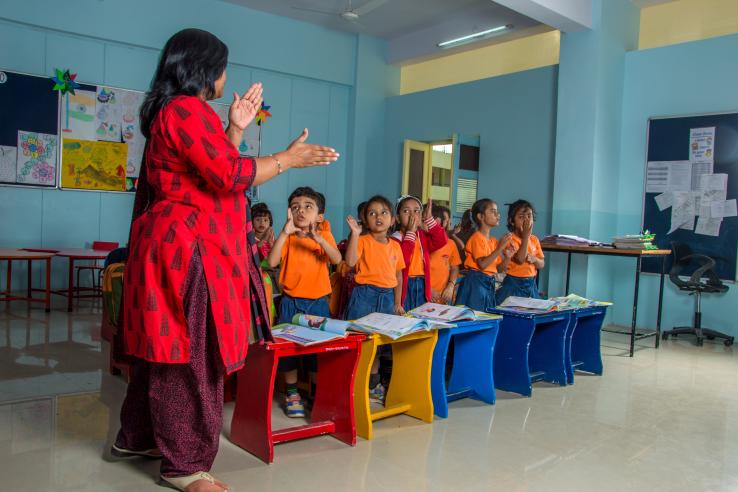
Students in a classroom facing the front where a teacher and student stand.
Evaluation

Impacts and Challenges of a Teacher Training Program in Nepal

Training teachers to improve teacher quality and student learning is a common strategy taken by policymakers. In Nepal, researchers conducted a randomized evaluation of a government teacher training program for math and science teachers to evaluate the impact on student learning in secondary schools.
Seated woman showing pieces of cloth to another woman
Evaluation

Leveraging Business Networks to Boost Women’s Entrepreneurship

Researchers investigated the role of online networking groups (via WhatsApp) and free legal aid on improving business innovation, practices, sales, and profits among growth-oriented women-owned firms in Ghana. They found that online networking groups meaningfully encouraged business innovation, improved participants’ business practices, and boosted firm profits.
white hand holds cell phone with police cars blurred in background
Evaluation

The Impact of Informational Interventions about Police Alternatives on Police Reliance in the United States

Researchers conducted a randomized evaluation to test the impact of providing information about police alternatives on individuals' reported likelihood of calling the police and a follow-up randomized evaluation to understand key public-safety stakeholders’ receptiveness of police alternatives. The first study found that information about police alternatives had a bipartisan decrease on police reliance in nonviolent scenarios. The second study revealed that police are more responsive to evidence on public interest in police alternatives when it is presented using some framing devices compared to others.
A group of community members arranged in a circle in a social engagement
Evaluation

The Impact of Broadening Traditional Leaders’ Advisors on Inclusive Governance in Zimbabwe

Researchers conducted a randomized evaluation to test how encouraging traditional leaders to broaden their circle of advisors affects inclusive governance in Zimbabwe. Village chiefs improved their decision-making processes when they attended the workshop on inclusive and transparent governance and were accompanied by a civil society member.
Evaluation

Impact of school-based training on social cohesion for immigrant children in Finland

Researchers partnered with a local non-profit, Walter, to evaluate the effectiveness of two school-based social cohesion interventions for immigrants’ children in Finnish schools.
women with pen and paper
Evaluation

Impact of Digital Financial Education and Information Provision on Gender-Based Violence in Colombia

In Colombia, researchers conducted a randomized evaluation to test the impact of a messaging-based program via WhatsApp focused on financial education, couples’ communication, and information provision on financial capability, women’s empowerment, and intimate partner violence.
Three girls wearing hijabs sit in a classroom holding books and other learning materials
Evaluation

Learning beyond school: the impact of a remedial learning and literacy program on out-of-school girls in Pakistan

This project used a randomized evaluation to study the effect of a learning program targeting adolescent girls on their education, aspirations, and empowerment.
 A group of women gather around a roadside tap, filling their containers with water.
Evaluation

Delivering Clean Water to Households in India

More than two billion people around the world lack access to clean drinking water, and current approaches to increasing access have fallen short. Researchers conducted a randomized evaluation to test the impact of delivering clean water directly to households on the valuation of clean water, and other water-related benefits in India.
Farmer harvesting maize in Uganda
Evaluation

The Impact of Quality Upgrading and Market Access on Farmers’ Productivity and Profits in Uganda

In western Uganda, researchers conducted a series of randomized evaluations that assessed the impact of introducing a combination of post-harvest services, training on agricultural best practices, and access to a market for high-quality maize on farmers’ productivity and profits. Researchers found that the extension services only intervention had little to no impacts on productivity and farmer profits.
early childhood education in Morocco
Evaluation

Building Preschools to Improve Child Development and Mothers' Agency in Morocco

Researchers are conducting a randomized evaluation to measure a major preschool construction program underway in Morocco.
Students sit together and look at a laptop screen
Evaluation

The Impacts of Computer-Based Individualized Instruction on Math Learning in India

In partnership with an education assessment firm, researchers conducted a randomized evaluation to isolate the impact of computer-based individualized instruction in India. After nine months, lower-performing students in grades six to eight learned 22 percent of a standard deviation more in math if offered materials that matched their learning levels. For the average student, individualized instruction did not affect math learning.
Image of voters stopping by political party booths in Honduras.
Evaluation

Impacts of Conditional Cash Transfer Programs on Voting in Honduras

In this randomized evaluation in Honduras, researchers assessed how the national Programa de Asignación Familiar (Family Allowance Program) CCT program, which provided a combination of transfers to households and transfers to support public goods, influenced voting in local and national elections. In municipalities where households received direct transfers, incumbent mayors faced a higher likelihood of re-election (an increase of 39 percent), but there was no impact on presidential election outcomes for any combination of transfers.
Woman sits in a medical setting
Evaluation

Changing Financial Incentives for Medicare Providers to Encourage Home Dialysis in the United States

Researchers analyzed the impact of a new reimbursement model to incentivize end-stage kidney disease providers and facilities to provide home dialysis on home dialysis rates. During the first year of the study, there was no statistically significant difference in home dialysis rates between hospital referral regions randomly assigned to the new reimbursement model and those that used the old model.

Pagination

  • Current page 1
  • Page 2
  • Page 3
  • Page 4
  • Page 5
  • …
  • Next page ›
  • Last page Last »
J-PAL

J-PAL

400 Main Street

E19-201

Cambridge, MA 02142

USA

Contact

+1 617 324 6566

[email protected]


Press Room

Stay Informed

Receive our newsletters

Subscribe


Privacy Policy

Accessibility

MIT